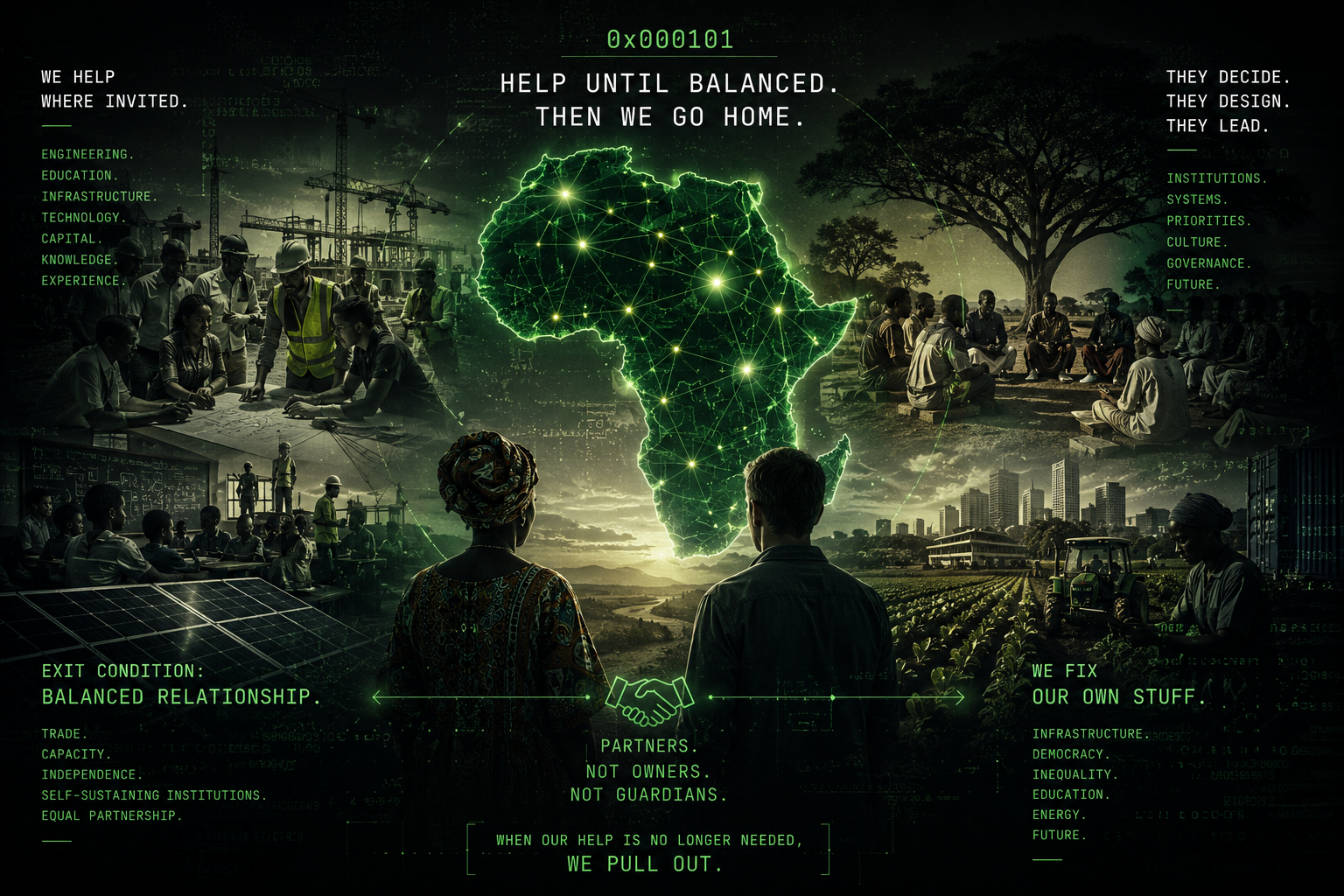
0x000101 What if we stop going to Africa and telling people how their country should work?
A thought experiment about self-determination, support, and whether help can lead to real independence.
Help where invited. Partners, not owners. When help is no longer needed, we pull out.
What if we stop going to Africa and telling people how their country should work?
That sentence is already wrong.
“Africa.”
Fifty plus countries.
Thousands of languages and communities.
Completely different histories.
So there probably isn't one answer.
Good.
That is kind of the point.
Something different.
What if one country, region or community says:
We want to try something different.
Not a copy of a European parliament.
Not the American model.
Not whatever system the former colonial power left behind.
And not some foreign consultant arriving with a PowerPoint called “good governance.”
Something they develop themselves.
Maybe they want a normal parliament.
Maybe they don't.
Maybe elected politicians run everyday government, but another council exists for the long term.
People who don't have to campaign every four years.
Scientists.
Farmers.
Teachers.
Business people.
Traditional leaders.
Young people.
Whoever that society actually considers worth listening to.
Who decides who is wise?
I called it a council of wise people at first.
Then you immediately hit the obvious problem:
Who decides who is wise?
And that gets nasty surprisingly quickly.
If government chooses them, government controls the council.
If the council chooses itself, you created an elite.
If everybody votes for them, we're basically back at another election.
If universities choose them, we decided university education equals wisdom.
If age decides, young people lose.
If tradition decides, maybe old power structures never disappear.
So I don't know how you select them.
But I still think the question is worth asking.
Why do we automatically assume that the people who are best at winning an election are also the people we want thinking thirty years ahead?
Maybe they are.
Maybe they aren't.
Now the other part. Europe.
I don't mean Europe goes there and builds the new system.
That would just be the same story again with nicer words.
I mean:
They tell us where they actually want help.
If they need engineers, send engineers.
If they need infrastructure, help build infrastructure.
If they need universities, technology, administration, financing, whatever it is, fine.
But we don't get a piece of their political system because we helped pay for it.
No permanent seat.
No hidden ownership.
No “we gave you this, therefore now you owe us that.”
And as soon as they don't need us anymore, we go home.
Actually go home.
That sounds obvious until you think about how strange that would be.
Because if the help really works, our influence gets smaller.
Not bigger.
And that makes me wonder how much “help” in international politics is actually designed to end.
Which brings me to trade.
This part is deliberately rough.
What if one of the goals is that the relationship eventually balances out?
Not necessarily some perfect accounting equation where imports equal exports down to the euro.
That's too simple.
I mean balance in the relationship.
A country shouldn't permanently export cheap raw material and buy back the expensive finished product.
It shouldn't need foreign engineers forever to maintain the infrastructure that foreign engineers built.
It shouldn't depend permanently on foreign money just to keep the system running.
At some point, help should start disappearing.
If it doesn't, maybe we didn't help.
Maybe we just built a nicer dependency.
And meanwhile Europe has enough of its own problems.
Energy.
Infrastructure.
Education.
Demographics.
Political trust.
Housing.
Inequality.
We don't arrive as the finished model.
We go back and fix our own stuff.
Maybe twenty years later both sides meet again and neither one is the “helper.”
Just two places with different strengths, different problems, buying things from each other, arguing with each other and sometimes asking each other for help.
Normal.
There is another problem though.
What happens if the system they design is something we don't like?
That's where this idea becomes uncomfortable.
It is easy to say:
They should decide for themselves.
Until they decide something that violates what we consider democratic, fair or humane.
Then what?
Do we still respect self-determination?
Or was our offer only valid as long as they eventually built something that looks enough like us?
And what if they ask for something from us that benefits them but hurts us economically?
Do we still help?
What if more local production means fewer European companies making money there?
What if balanced trade means we lose an advantage?
What if successful development means they no longer need our experts, our loans or our political approval?
Would we still call that success?
I think that is the actual question.
How can Europe fix Africa?
That question is already broken.
Can we help somebody become independent from us and still be happy when they actually do?