0x000100 What if we call a public United Nations council?
We keep calling problems global. We keep saying humanity must act. But humanity itself is almost never asked directly.
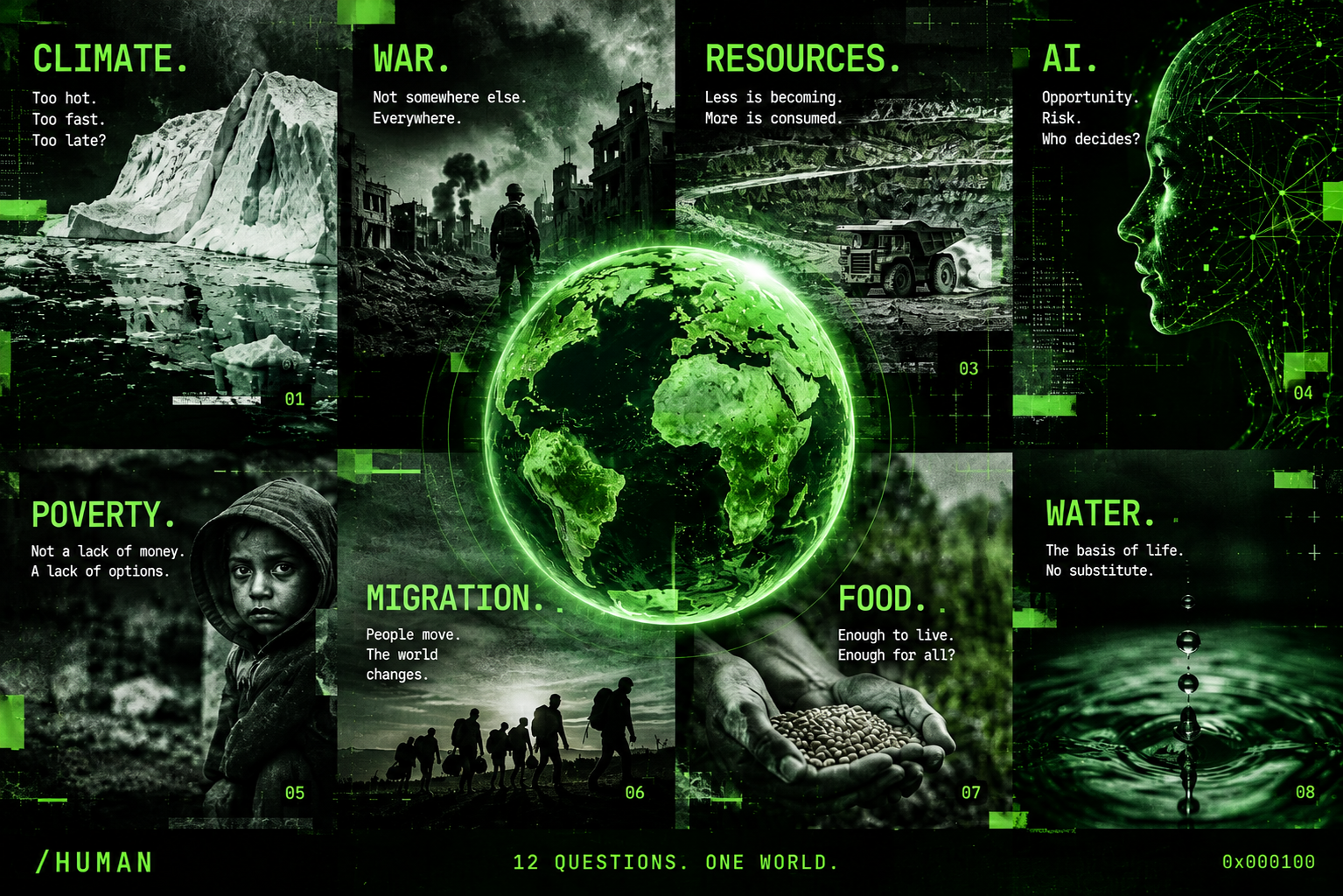
Eight possible global questions. Not the final twelve. Even choosing examples already exercises power.
What if we ask humanity directly?
We call problems global.
We say humanity must act.
But humanity itself is almost never asked.
So: a public United Nations council.
Not another meeting where governments talk for months and afterwards everybody tells us what was agreed.
I mean public.
Online.
Every president, prime minister, scientist, organisation, critic, whatever side you are on.
Everybody can make their case.
And then we ask the people.
Not about every law.
Not about things a town, a country or even a continent can deal with on its own.
Only about the few things where we keep saying:
This is a global problem.
Fine.
Then why don't we ask the globe?
Not world government. Not a new UN. Just one experiment.
Maybe twelve questions.
Climate.
War.
Resources.
AI.
Poverty.
Migration.
Food.
Water.
Eight already came into my head.
And that is the first problem.
I just named them.
Why these eight?
Why should I get to choose?
Why should the UN?
Why should the US, China, Europe, India or anybody else decide which twelve questions humanity is allowed to answer?
So perhaps the first question isn't one of the twelve.
Perhaps the first question is:
What are the twelve questions?
Everybody can submit questions. Fine.
Who reduces millions of questions to twelve?
Make the process transparent. Fine.
Who designs that process?
Use experts. Fine.
Who chooses the experts?
Already difficult.
Then translation.
If I ask somebody in Germany, Nigeria, China and Brazil the same political question, did I actually ask the same question?
The words can be translated.
The meaning maybe not.
Even something that sounds simple like freedom, fairness or responsibility can mean slightly different things depending on language, history and culture.
So before we even vote, we have to ask:
Can eight billion people really answer the same question?
Then comes information.
We like the idea of one person, one vote.
Sounds fair.
But one person owns a phone.
Another owns a newspaper.
Another owns a social network.
Another owns an AI company.
Another doesn't even have reliable internet.
All votes may technically count as one.
Their ability to influence the other votes definitely doesn't.
Equal votes do not create equal influence.
Another crack in the idea.
So now we need a system where arguments can be heard without whoever has the most money simply buying the biggest microphone.
Scientists explain what we know.
People affected explain what it means in real life.
Governments argue their position.
Opposition argues against it.
Everybody can see both.
Nobody gets to remove the inconvenient part.
But who is “everybody”?
Imagine five billion people vote.
That would be extraordinary.
But three billion didn't.
Can five billion people speak for humanity?
Children.
People without reliable access.
People unable to participate.
Future generations.
The word everybody gets smaller the closer you look at it.
Then we vote.
One human. One vote.
And here it gets interesting.
Imagine 75 percent agree.
Then one of the most powerful governments says:
No.
Now what?
We keep saying governments represent their people.
But if their people just directly answered the question, who represents whom?
And what if the government says yes?
Who implements the decision?
Who pays?
What happens to a country that refuses?
Does a global majority have the right to impose something on a national minority?
A result can have meaning without having authority.
BEFORE THE VOTE
And don't misunderstand the idea.
A majority isn't automatically right.
Five billion people can still be wrong.
Afraid.
Angry.
Manipulated.
Misinformed.
A majority can also be cruel to a minority.
So there must be things we cannot simply vote away.
Human rights, perhaps.
But then somebody has to decide what sits above the vote.
And suddenly we are back where we started.
Someone has power before voting even begins.
That is the part I can't get out of my head.
Maybe the technical problem was never the real problem.
Maybe the moment everybody gets a vote, we discover how many decisions happen before anybody votes.
Who asks.
Who explains.
Who translates.
Who decides what is fact.
Who decides what cannot be voted on.
Who participates.
Who counts.
Who accepts the result.
Who implements it.
And who can still say:
No.
WHAT IF;
What if we actually tried it once?
Not world government.
Not abolishing countries.
Not replacing representative democracy.
Just an experiment.
Maybe the most interesting result would not be the twelve answers.
Maybe it would be finding out whether there is such a thing as “we” in the first place.