
We all have this one jar.
It is no bigger for people who seem to keep everything under control. And it does not become smaller just because too much is going on right now.
The jar represents something that is quite limited for all of us: our time, our attention and, ultimately, our life.
The familiar idea behind it is simple.
The large stones go into the jar first.
The things without which our life eventually loses its balance: sleep. Food. Health. Family. Friendship. Movement. Community. A hobby. Learning. Rest.
Perhaps also something that simply brings us joy or gives us the feeling that we belong somewhere.
After that, there is still room.
Smaller stones fit between the large ones. Appointments, tasks, messages, things that need to be done.
And even then, sand still finds its way through the gaps.
Perhaps the problem does not begin with having too little time.
Perhaps sometimes we simply begin at the wrong end.
When the sand comes first
Look at the phone for a few minutes.
Reply to a message.
One more video.
Just quickly see what happened.
Another notification.
Another post.
None of this is particularly dramatic on its own.
That is exactly why it works so well.
They are tiny grains.
But sand has an interesting quality:
It finds every gap.
And if we pour it into the jar first, it can take up a surprising amount of space.
Eventually we try to squeeze the large stones in somehow.
Sleep gets shorter.
Exercise is cancelled today.
There is no time for the hobby right now.
We have a conversation while holding the phone in our hand.
And something that actually matters to us gets postponed until tomorrow.
Not because it suddenly became unimportant to us.
But because the jar is already full.
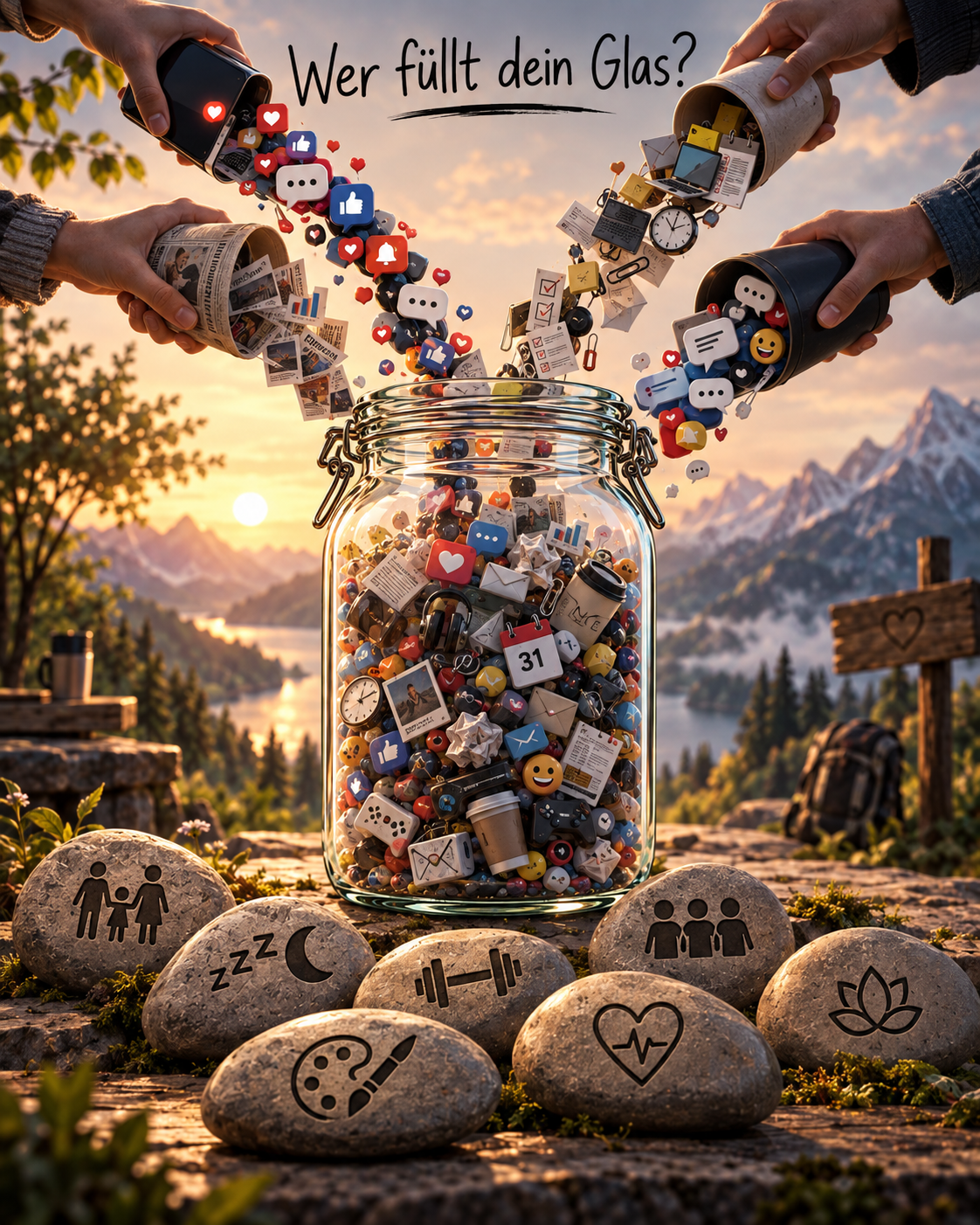
The algorithm does not know our large stones
The idea for this illustration came partly after watching the Checker Tobi report “School without smartphones – the experiment with Tobi Krell”.
What stayed with me was not so much whether smartphones are fundamentally good or bad.
I find another question more interesting:
Who actually decides
what fills our attention?
An algorithm does not know that Tuesday evening practice might be exactly where a child meets friends, develops confidence and spends ninety minutes fully absorbed in one thing.
It does not know that someone switches off while drawing.
That a conversation at the kitchen table can matter more than twenty messages.
Or that boredom is sometimes precisely the space from which an idea emerges.
The algorithm does not know these things.
It only knows our attention.
And it is very good at holding on to it.
An empty jar does not stay empty for long
Perhaps there is another side to this metaphor.
What happens when there are hardly any large stones in the jar to begin with?
Free time sounds like freedom. But attention does not automatically remain untouched just because nothing has been planned yet.
When nothing else pulls us – no hobby, no meeting, no project, no curiosity, no place where we want to be – the digital sand is always available.
A screen needs no appointment.
It begins immediately.
Open space is valuable. But it rarely stays simply empty.

Perhaps that is why we need the large stones
In a calendar, these things can sometimes look like additional obligations.
But perhaps they are exactly the opposite.
They put large stones into the jar.
They deliberately take up space and, in doing so, prevent that space from being filled completely by something else.
I find this thought especially interesting for children and teenagers.
We talk a lot about screen time and how many hours are still acceptable.
What exists beyond the screen
that is worth putting the phone down for?
The image is not a perfect plan for life
Of course, real life does not work like a preserving jar.
Sometimes an entire week is simply sand.
Sometimes something happens that throws every priority into disarray.
And sometimes we spend an evening pointlessly scrolling through nonsense on the sofa.
That probably belongs to life as well.
So, for me, the essential point is not to own a perfectly sorted jar.
It is to notice what is inside it at all.
Perhaps imbalance sometimes becomes visible in precisely this way:
The large stones no longer find a place.
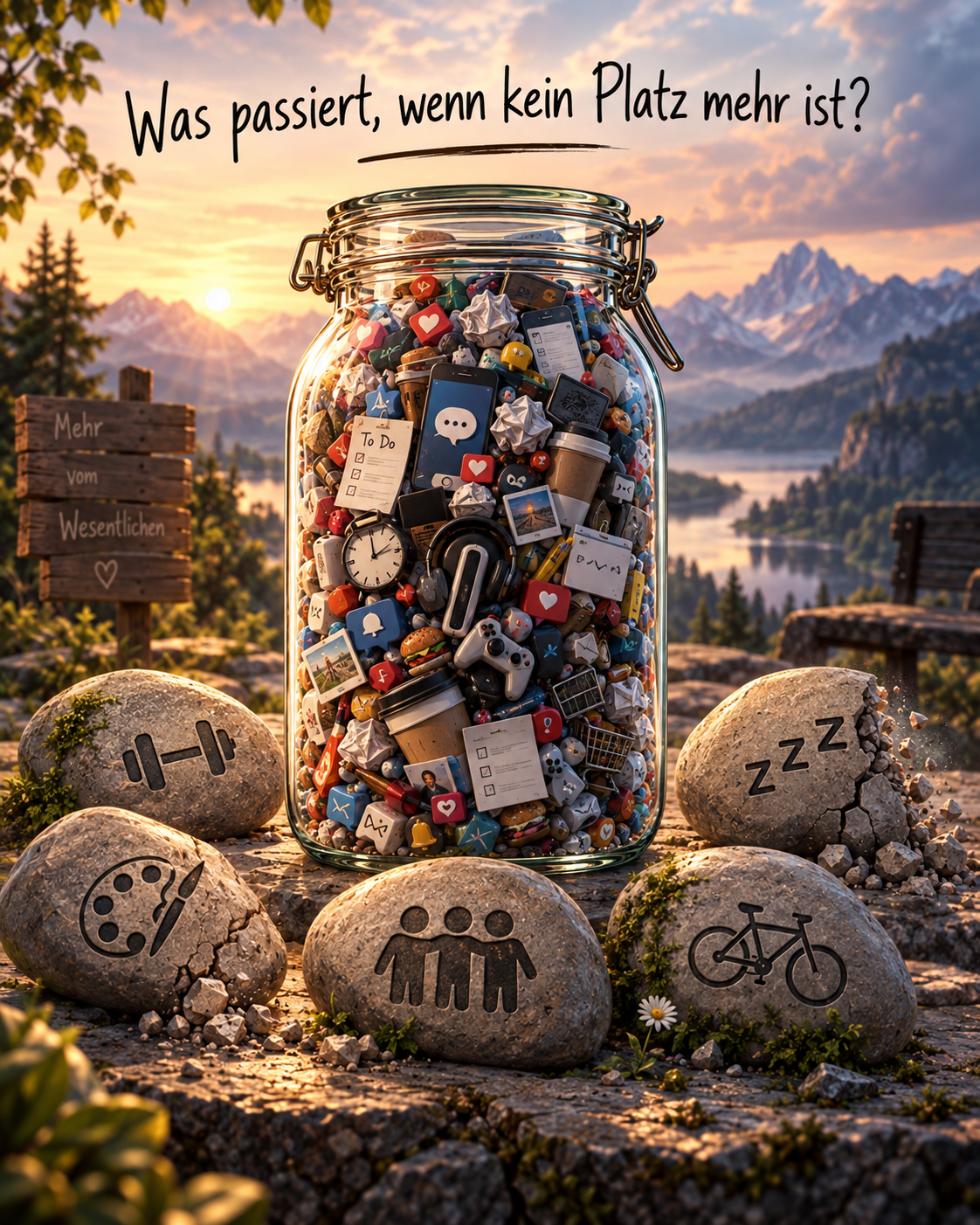
Perhaps it is not only our calendar that changes in the process. Our priorities can shift as well. “I do not have time for that today” may eventually become “I suppose that is simply not for me anymore.” Not necessarily because the large stone has become unimportant, but because we have given it no space for a long time.
What deserves space first?
Perhaps, in the end, it is not about filling the jar perfectly.
It is about knowing what our own large stones truly are.
Not everyone needs the same stones.
But if we do not know what ours are, it becomes difficult to give them space first.
And perhaps that is exactly where the real choice begins.