I was thinking about returning to a place.
Not time travel.
Just returning.
I leave home in the morning and come back in the evening. I call that a return without thinking about it.
Then something started bothering me.
What does it actually mean to return?
The room looks the same.
The chair is still near the window. My keys are where I left them. I recognize the light switch in the dark.
But the afternoon light has gone. The air is warmer. Dust has moved. The clock continued. Cells in my body changed, and I came back carrying memories I did not have when I left.
I can point to the same room. I cannot point to the same state.
Same place. Different state.
State A — I leave
Approximately the same
Address
room
coordinates
Definitely different
Light
air
temperature
body
memories
observer
Returned to the placeDid not return to the state
Nothing waited for me.
The room changed while I was gone. So did the building and the street. Earth rotated and continued around the Sun. The Solar System moved with the galaxy.
This does not make the word return useless. It makes it less exact than it sounds. We return by choosing a frame and ignoring most of what changed.
This is the part I cannot get around.
At first I thought this was simply about movement. It isn't. Or at least I don't think it is.
The person who saw the room in the morning cannot observe that state again. By evening I have additional memories. My body is different. Even if the room could be restored atom by atom, I would arrive knowing that it had been restored.
The observer is not standing outside the change. The observer is one of the things changing.
I needed a name for the direction between states.
I call it the Universal Gradient.
I do not mean a new force or another dimension, and I am not trying to replace time with a new term. It is only a way of picturing continuous change:
previous state→current state→possible states
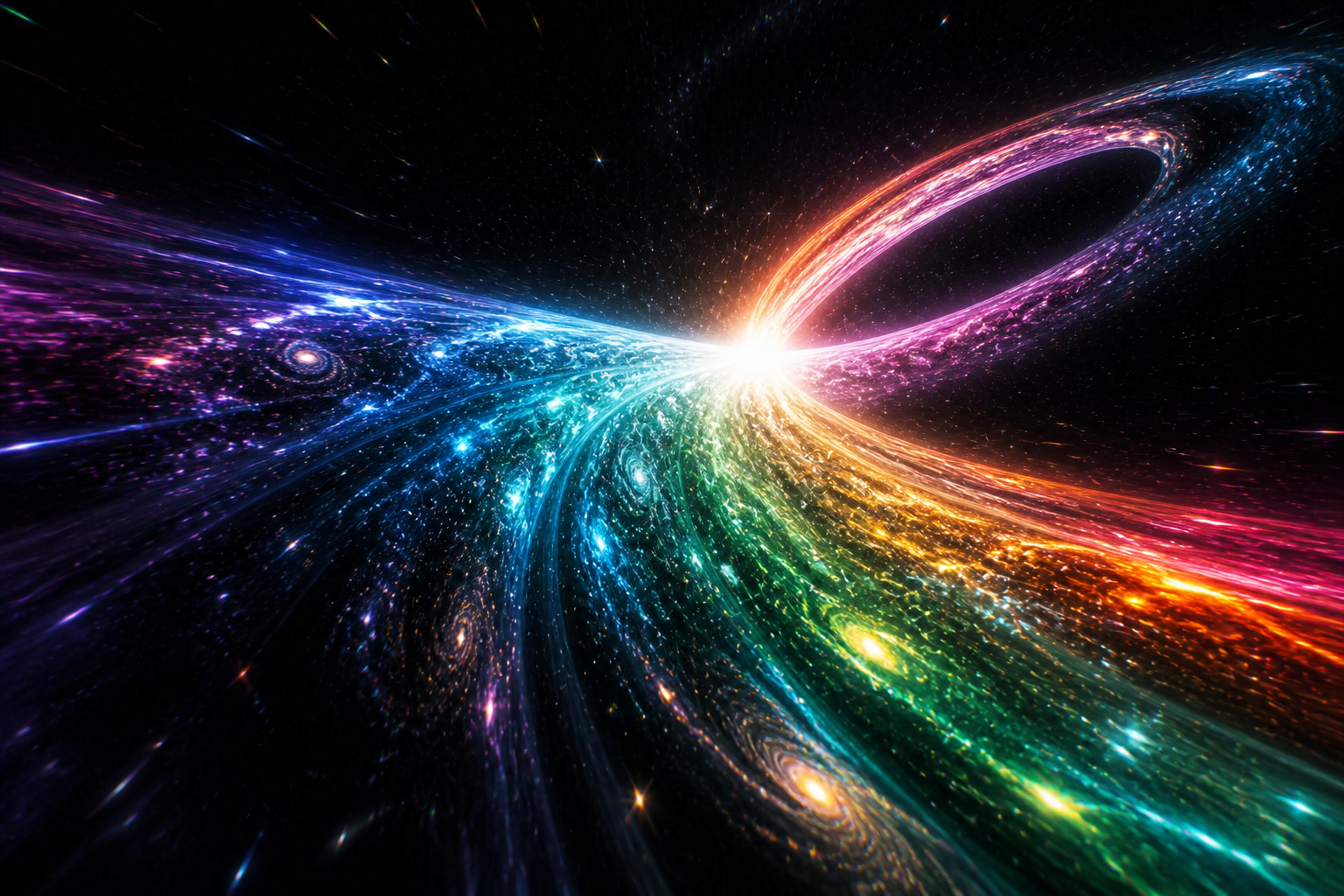
The illustration turns that idea into a path. Black becomes color, color approaches white, and the path curves back toward black. The shape returns. Its contents do not.
This is not a theory of time.
Relativity gives physics a model of space and time. Thermodynamics helps explain why many macroscopic processes have a direction: in an isolated system, entropy does not decrease.
The Universal Gradient does not replace either idea. My question is narrower and more personal: what does time mean to an observer who is permanently part of the change being observed?
The thought does not stay in the room.
Memory
A memory happens now. It is not the earlier moment opening again. I remember from the state I am in today.
Identity
I still call myself the same person. That continuity matters. But sameness of identity is not sameness of state.
Decisions
I can reverse a decision. I cannot remove the fact that I made it, lived with it, and became the person now trying to reverse it.
Waiting
Not deciding does not preserve the present. The system keeps changing. So do I. Waiting is also movement.
You can go home.
You can revisit a memory.
You can undo a decision.
You can rebuild what was broken.
But none of these things restore the previous state.
Then what exactly do we mean when we say:
back?