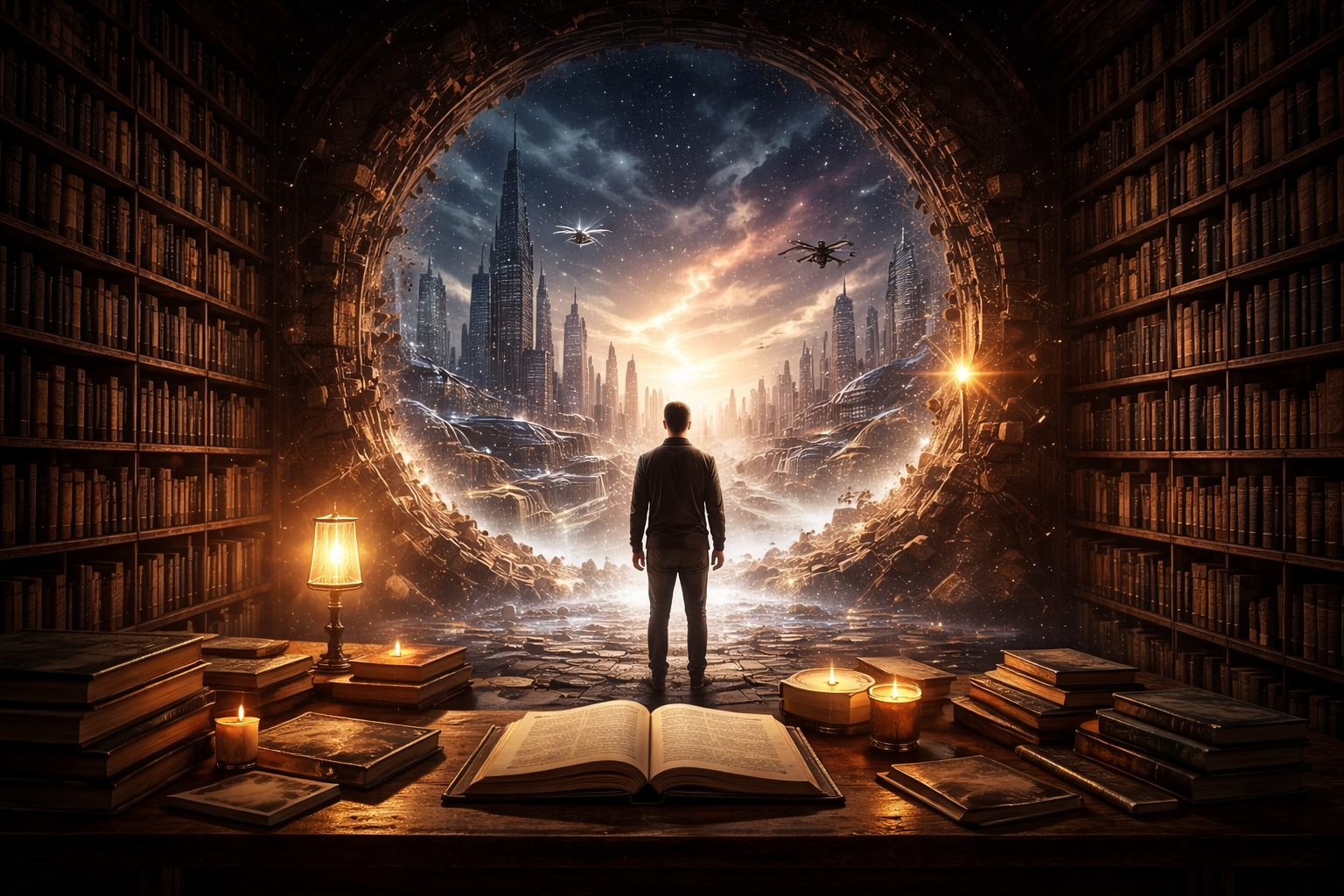
Art, literature, and film have engaged with the idea of the future long before technology reached its current speed and scale. Not as speculation, but as reflection. Not as entertainment, but as warning.
These stories did not emerge by accident. They exist because every vision of the future is also a statement about power, values, and responsibility. The future has never been neutral. It has always carried consequences.
For generations shaped by these narratives, this is evident. Stories such as Dune, Terminator, and The Matrix were never primarily about technology. They were about control, dependence, and the fragile boundary between creation and domination. They asked who holds power, who defines progress, and what is lost when efficiency replaces judgment.
Other works confronted humanity with its darkest capacities. Films such as Schindler’s List, Life Is Beautiful, Inglourious Basterds, Pulp Fiction, and Trainspotting reveal how cruelty and compassion coexist. They show how easily moral certainty collapses under pressure and how thin the line is between what is considered right and what is justified as necessary. These stories do not exaggerate. They expose.
Dystopian narratives were never predictions. They were tests. Works such as 1984 and Animal Farm demonstrate how fear, ideology, and power distort even the most idealistic revolutions. They show that good intentions do not protect against corruption and that systems often outgrow the people they were meant to serve.
More recent narratives extend this warning into the digital age. Stories like Ready Player One, The Zero Theorem, 3 Percent, and The Platform depict a world where reality becomes optional, identity dissolves into virtual constructs, and meaning is replaced by distraction. They do not claim inevitability. They show the cost of disengagement.
Other works focus less on collapse and more on responsibility. Arrival emphasizes communication and empathy as prerequisites for understanding, both between species and within humanity itself. Ex Machina interrogates the boundaries between human and machine, exposing how intelligence without ethics becomes manipulation. Interstellar places human ambition against cosmic scale, reminding us that while existence is fragile, cooperation and imagination remain essential.
Ignoring these questions is no longer possible. Technological acceleration, geopolitical instability, ecological limits, and social fragmentation are not isolated phenomena. They form a single landscape of pressure that demands reflection and maturity.
Digital systems reshape identity and community. Climate instability exposes the fragility of comfort and growth. Political and economic systems demonstrate how quickly fear can replace solidarity. These developments are not abstract. They define lived reality.
Philosophy has long prepared humanity for such moments. Thinkers such as Thus Spoke Zarathustra, The Antichrist, Critique of Pure Reason, Perpetual Peace, Faust, and The Idea of the Holy insisted that reason, ethics, and responsibility must guide action. They warned that knowledge without wisdom and power without reflection lead to collapse.
Contemporary voices continue this examination. Works such as Sapiens, Homo Deus, and Twilight of Democracy analyze humanity’s trajectory and its recurring failures. Scientists and communicators including Stephen Hawking, Neil deGrasse Tyson, Harald Lesch, Eckart von Hirschhausen, David Attenborough, and Brian Cox provide clarity, not comfort, by revealing scale, consequence, and responsibility.
The stories warned us.
They showed that progress without ethics accelerates harm.
That systems without empathy dehumanize.
That power without reflection corrodes.
What follows is not destiny.
It is choice.